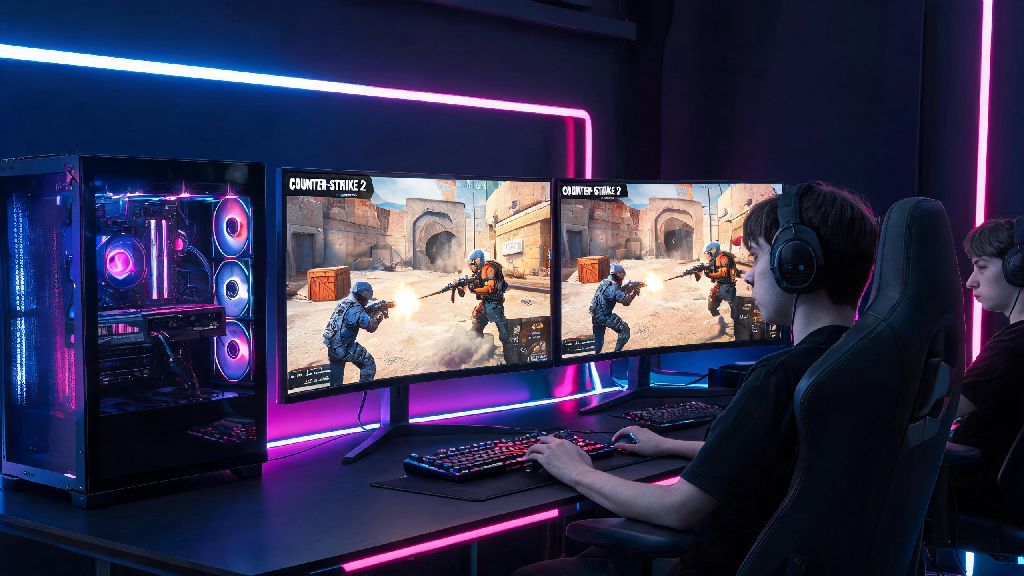
If you’ve spent any time in the Counter Strike community lately, you’ve probably heard all the hype around the Source 2 port of the classic CS: Source. It’s smoother, has better graphics, and retains all the chaotic fun of the original, but it can feel pretty overwhelming if you’re jumping in for the first time, even if you’ve played other CS titles before. I’ve logged over 140 hours in the Source 2 version since its release, and I made every possible mistake when I first started, so I put this guide together to help you skip the frustration. By the end, you’ll know exactly how to play Counter Strike Source 2 and feel confident jumping into your first public lobby.
Core Basics You Need to Know Before You Learn How to Play Counter Strike Source 2
At its core, the game follows the same classic Counter Strike loop that fans have loved for decades. You’ll be placed on either the Terrorist or Counter-Terrorist team for each match, with rotating objectives depending on the map you’re playing. Terrorists are usually tasked with planting a bomb at one of two designated sites, while Counter-Terrorists have to either defuse the bomb after it’s planted or prevent it from being planted at all. Some maps use a hostage rescue objective instead, where Counter-Terrorists have to retrieve hostages held by Terrorists and bring them back to a safe zone.
Before you jump into your first match, there are three non-negotiable rules you need to memorize to avoid getting kicked or letting your team down:
Economy management is the single most important skill for new players to master first, even before you work on your aim. I’ve seen teams full of players with 2.0+ K/Ds lose entire matches because they kept buying expensive rifles every round and ran out of cash when it counted. If your team loses three rounds in a row, agree to do a “force buy” with pistols and light armor, or save all your cash for the next round so you can come back with full gear.
Movement and Gunplay Tips to Outplay Opponents Consistently
Source 2’s updated physics engine changes movement a bit from the original CS: Source, so even veteran players need a few hours to adjust to the new feel. Bunny hopping is still possible, but the timing for air strafes is a little tighter, so don’t worry if you can’t pull it off right away – you don’t need it to win most casual matches. Standing completely still when you shoot will instantly double your accuracy, even if you’re using a fully automatic rifle. Running and gunning only works if you’re using a shotgun or SMG at very close range, so get in the habit of stopping for half a second before you pull the trigger.
Every gun in the game has a fixed recoil pattern that you can learn with 10 to 15 minutes of practice in a custom aim map. For the AK-47, the most popular rifle in the game, the recoil pulls up and to the right, so you can counter it by pulling your mouse down and to the left as you shoot. You don’t have to memorize every gun’s pattern right away, but learning one or two primary weapons will help you climb the ranks fast. I recommend starting with the AK-47 for Terrorists and the M4A1-S for Counter-Terrorists, since they’re the most forgiving for new players and used by almost everyone at higher ranks.
When you’re peeking around corners, don’t wide peek and expose your entire body to enemies holding the angle. Use small shoulder peeks to bait out shots first, so you can see where an enemy is positioned without risking getting one-shot. If you know an enemy is holding a corner, you can also jump peek to throw off their aim before you take your shot.
Matchmaking and Lobby Settings to Get the Best Experience
You have a lot of options for lobbies when you first start, so don’t jump straight into competitive ranked matches unless you have at least 40 to 50 hours of playtime under your belt. Casual lobbies are designed for low-stakes fun, and you won’t get penalized for leaving or having a bad game, so they’re the perfect place to learn the maps and game mechanics. Adjust your in-game settings before your first match to cut down on input lag and give yourself a level playing field. Turn off VSync if you have a 144Hz or higher refresh rate monitor, turn on raw input to bypass Windows mouse acceleration, and lower shadow and particle settings if you’re getting consistent frame drops below 60 FPS.
Your crosshair settings also make a big difference in your aim. Don’t stick with the default giant, dynamic crosshair that expands when you move. Go for a small, static crosshair in a bright color like neon green or cyan that stands out against all map backgrounds. You can find hundreds of pro player crosshair codes online to test out until you find one that feels right for you.
Don’t sleep on community servers either. There are thousands of custom servers running everything from deathmatch and aim training maps to silly game modes like zombie escape and prop hunt. They’re a great way to meet other players and practice specific skills without the pressure of official matchmaking. If you get kicked from a lobby for being new, don’t take it personally – a lot of long-time CS players take their casual matches very seriously, and there are hundreds of other lobbies you can join instead.
Common Mistakes New Players Make (And How to Fix Them Fast)
It’s normal to make a lot of mistakes when you first start, but there are a few common errors that hold 90% of new players back from improving quickly. The first is wasting all your cash on expensive rifles every single round, even when your team is on a losing streak. If more than half your team can only afford a pistol, you shouldn’t buy a $2700 rifle either – you’ll leave your team outgunned the next round if you lose and run out of cash. The second mistake is ignoring utility completely. Utility (smokes, flashbangs, molotovs, and HE grenades) wins more rounds than perfect aim, especially in competitive play. A well-placed smoke can block an entire site’s line of sight so your team can plant the bomb safely, and a well-timed flashbang can blind three or four enemies holding a corner so you can push without taking damage.
The third most common mistake is trying to get a kill every single round, even if it means risking the entire objective. You don’t have to top the scoreboard every match to be a valuable team member. I once won a competitive match where I only had 7 kills total, but I threw 14 successful smokes, watched the back flank for my team the entire game, and defused the bomb twice to win rounds. If your team needs someone to watch a quiet corner instead of pushing the site with the rest of the group, do it – those small plays add up to wins way more than random kills.
Another common mistake is not learning callouts for the maps you play most. Every part of every standard map has a universally agreed-upon name, like “A long” or “B site closet”, so you can quickly tell your team where enemies are spotted. You don’t have to memorize all callouts for every map right away, but learning the ones for the two or three maps you play most will make you a much better team player.
At the end of the day, the best way to get better is to just play and have fun. You’re going to lose a lot of matches when you first start, and you’re going to get outplayed by players who have been around for years, but that’s all part of the process. Once you get the hang of how to play Counter Strike Source 2, you’ll find it’s one of the most rewarding FPS games ever made, with a dedicated community and endless content to keep you playing for hundreds of hours. Don’t be afraid to ask more experienced players for tips, and take every loss as a chance to learn something new for your next match.